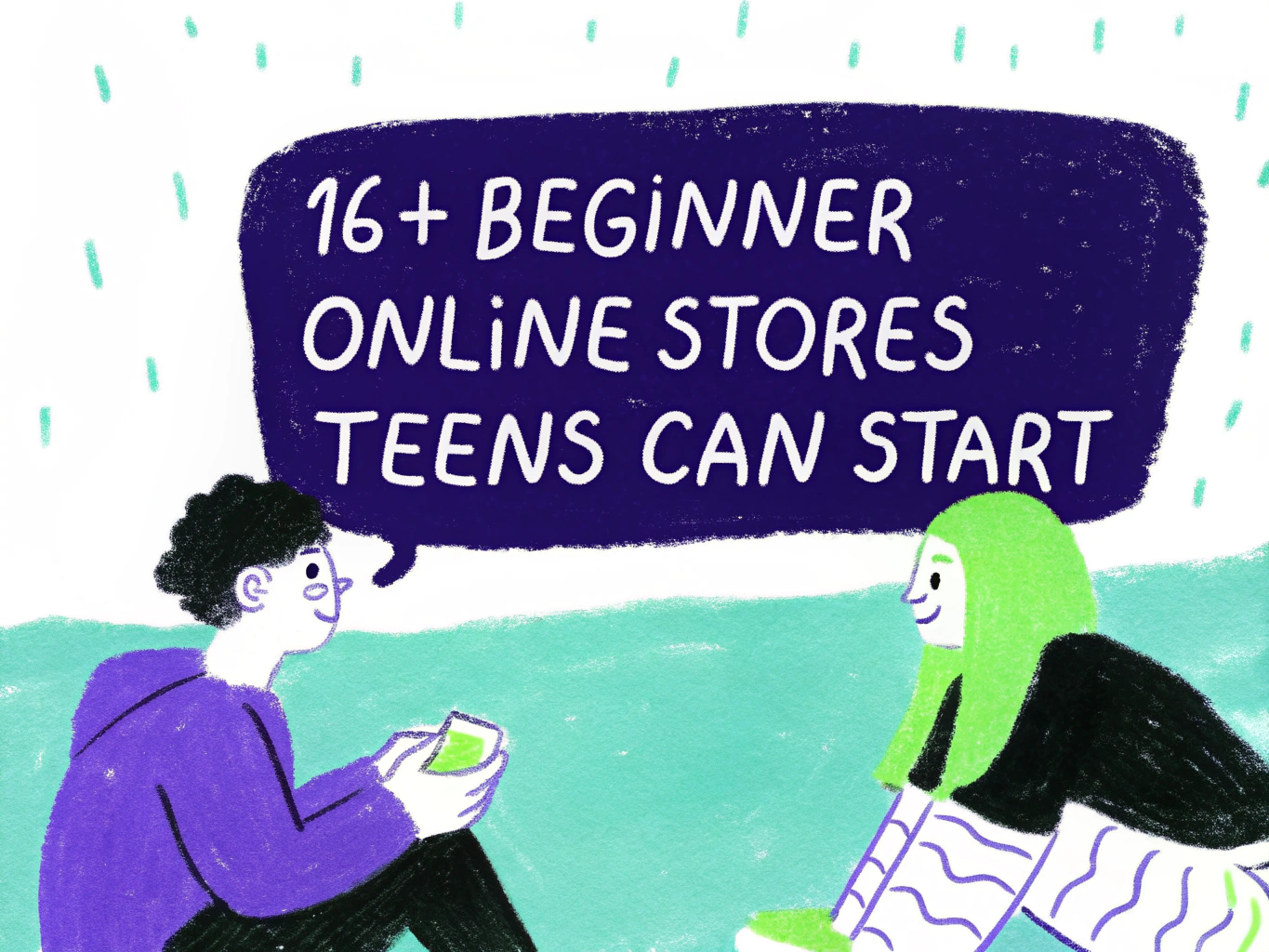
16+ Beginner Online Stores Teens Can Start
Starting an online store as a teenager in 2026 is genuinely accessible in a way it has never been before. The platforms exist, the tools are free or nearly free, and the global buyer base is sitting right there. Teen entrepreneurs are already changing the scope of ecommerce, with young founders building stores through print-on-demand, digital products, reselling, and handmade goods well before they have their driving licenses.
The honest reality is that not every online store type works equally well for teens. Some require more startup capital than makes sense at this stage. Some have such intense competition that a new teen store without an existing audience has almost no organic visibility. And some are widely recommended in articles written by people who have never actually built one.
This guide covers 16+ online store types that genuinely work for beginners in 2026, with honest notes on what each takes to start, what it costs, what it pays, and what age requirements apply.
One Thing to Know Before Choosing a Platform
Most major ecommerce platforms have minimum age requirements. Shopify requires users to be 18 to start a store independently, but teens can enlist a parent to manage the account on their behalf. Etsy requires account holders to be 18. Gumroad and most payment processors also require users to be 18. Redbubble, Depop, and Poshmark have more accessible age requirements for younger teens.
In Canada and the US, minors under 18 cannot sign legally binding contracts, which means a parent or guardian needs to be the official account holder for most platform agreements. This does not prevent a teen from running the day-to-day operations of a business. It means a parent opens the account and remains involved in the financial and legal aspects of the business. Starting that conversation with a supportive parent before you choose a platform is the most practical first step.
Digital Product Stores
1. Printable Template Shop on Etsy
Startup cost: $0.20 per listing. Everything else is free.
A printable template shop sells instant-download PDF files like study planners, habit trackers, budget worksheets, note-taking templates, and journal pages. Buyers purchase, download immediately, and print at home. You design in Canva using a free account, export as PDF, and the platform handles delivery automatically.
This is one of the most genuinely passive store types available because every listing works for you indefinitely once it is live. A well-optimized listing in a specific niche continues selling without additional work on your part. Digital study resources typically sell for $5 to $25 per download. Consistent shops in specific niches earn $200 to $1,000 or more per month over time.
Parental account setup required for Etsy. Many teen sellers operate successfully under a parent’s account with full parental knowledge and involvement.
2. Digital Sticker Shop
Startup cost: $0 with Canva free or around $13 for Procreate as a one-time purchase.
A digital sticker shop sells PNG files with transparent backgrounds designed for use in iPad planning apps like GoodNotes. Buyers download the files and use them to decorate their digital planners. Packs of 30 to 50 stickers priced at $4 to $7 generate volume through a buyer community that returns for every new collection.
The unique advantage of this store type is the repeat buyer behavior. Once a buyer finds a sticker creator whose aesthetic they love, they come back consistently. Building a recognizable aesthetic from the start rather than mixing unrelated styles creates the kind of shop identity that generates loyal customers.
3. Canva Template Store
Startup cost: $0 to $0.20 per listing.
A Canva template store sells editable design templates delivered as shareable Canva links. Social media post templates, resume templates, media kits, business card templates, and ebook layouts are all proven product types. The fundamental rule is using only free Canva elements so buyers on free accounts can fully edit everything. A cohesive kit of 20 coordinated templates converts significantly better than 20 unrelated individual templates grouped together.
4. Notion Template Store
Startup cost: $0. Notion is completely free.
A Notion template store sells pre-built organizational workspaces that buyers duplicate into their own Notion account with one click. Student semester planners, assignment trackers, freelancer client management systems, content creator dashboards, and budget trackers all have proven buyer demand. Simple templates sell for $5 to $12. Comprehensive system bundles sell for $15 to $30.
5. Digital Art Store on Redbubble
Startup cost: $0. Redbubble handles everything at no upfront cost.
Redbubble lets you upload original artwork that gets printed on t-shirts, phone cases, tote bags, stickers, and prints only when someone orders. You keep a percentage of every sale. You never handle inventory or shipping. Redbubble has more accessible age requirements than Etsy and Gumroad, making it one of the most practical starting platforms for younger teens.
Building your store around a specific illustration style or niche aesthetic consistently outperforms uploading random unrelated designs. A cohesive store identity with a recognizable visual style builds a following faster than a generic store trying to appeal to everyone.
6. Short Ebook and Guide Store
Startup cost: $0. Google Docs and Canva are both free.
A store selling short practical guides and ebooks written in Google Docs and designed in Canva costs nothing to start. The product is a 20 to 30 page PDF that answers one specific question for one specific person. Written in your own voice, covering something you have genuinely mastered or navigated successfully, a focused guide sells for $7 to $19 depending on niche and content quality.
The most important thing about this store type is specificity. A guide about something specific you know is more valuable than a comprehensive overview of a broad topic. Study strategies for a specific AP subject, a step-by-step guide to a skill you have mastered, or a resource built around an experience unique to your age and context are all ideas with genuine buyer potential.
Print-on-Demand Stores
7. Print-on-Demand T-Shirt and Merch Store
Startup cost: $0. The platform produces products only when someone orders.
A print-on-demand store turns your designs into physical products without you managing any inventory or shipping. T-shirts, hoodies, phone cases, tote bags, mugs, and prints are all standard product types. The platform prints and ships everything. You keep a margin on every sale.
The teens succeeding with print-on-demand stores are the ones who build around a specific niche community or aesthetic rather than uploading dozens of generic designs. A store built around a specific gaming subculture, a humor style, or a visual aesthetic finds its audience faster and builds repeat buyers more reliably than a general store trying to sell to everyone.
Redbubble and Printify are both accessible starting points. Printify integrates with Etsy for sellers with parental account setup. Platforms like Podbase cater specifically to creator-focused print-on-demand with a streamlined setup experience.
8. Custom Merchandise Store for a Content Channel
Startup cost: $0 to $1 per month depending on platform.
Teens who are already building an audience on YouTube, TikTok, or Instagram can open a merchandise store that sells branded products directly to their viewers. Platforms like Fourthwall are specifically designed for content creators and offer YouTube Product Shelf integration, allowing fans to purchase hoodies, stickers, and posters directly from videos.
This store type works best when an audience already exists, even a small one. A dedicated community of a few thousand viewers converts to merchandise buyers at rates that a cold audience on a marketplace never matches.
Handmade and Craft Stores
9. Handmade Jewelry and Accessories Store
Startup cost: $20 to $50 for initial materials. Listing fee of $0.20 per item on Etsy.
Handmade jewelry, resin accessories, beaded designs, and custom keychains have consistent demand from buyers who value the uniqueness and personal quality of handmade items over mass-produced alternatives. Selling both online through Etsy and at local craft fairs and school events builds two independent revenue streams and generates real-time feedback that makes products better faster.
Starting with affordable materials to test what sells before scaling up is the practical approach. Buyers leaving positive reviews on early listings provide social proof that makes future listings easier to sell.
10. Candle and Soap Making Store
Startup cost: $30 to $80 for a starter supply kit.
Candles are a perennial seller because they transform the atmosphere of a space in a way that few other affordable objects can. Starting at the kitchen counter with a small batch of candles, testing scent combinations, and building a distinctive brand identity around a specific aesthetic is an accessible handmade business with a clear path from local market sales to online expansion.
Craft fairs are a particularly effective early channel for candle and soap businesses because the in-person sensory experience of smelling a candle or testing a soap is difficult to replicate through photography alone. Early craft fair feedback helps you refine your product before investing heavily in an online presence.
11. Custom Embroidery and Textile Store
Startup cost: Under $20 for thread, a hoop, and a needle.
Hand embroidery on clothing, hats, tote bags, and home goods serves a dedicated market of buyers who value handmade uniqueness. A teen with embroidery skills can offer both custom commissioned pieces and ready-made designs. Selling through Etsy with parental account setup or through Instagram with direct payment via a parent-managed account are both practical approaches.
The learning curve is accessible enough that a dedicated beginner can produce sellable work within a few weeks of consistent practice. Starting with simple designs and building complexity as skill grows is the most sensible progression.
Reselling Stores
12. Thrift Flip Fashion Store on Depop
Startup cost: The cost of inventory from thrift stores. Can start with items from your own closet for $0.
A thrift flip store buys secondhand clothing at thrift stores and resells it for profit on Depop or Poshmark. Teens who have a strong sense of what sells in a specific category — vintage clothing, specific brands, particular aesthetic styles — have a genuine trend awareness advantage over older resellers who are slower to identify emerging demand.
Strong photography against a clean background, accurate detailed measurements and descriptions, and small personal touches like careful packaging and a handwritten thank-you note are what separate the stores that build a loyal following from those that make occasional random sales. Poshmark requires users to be 13 or older with parental consent.
13. Curated Vintage and Collectibles Store on eBay
Startup cost: The cost of sourced items. Starts as low as $5 to $20 for first inventory.
A curated vintage and collectibles store on eBay sells specific categories of items — old video games, vintage toys, specific collectible figures, particular book editions, or niche memorabilia — to buyers who know exactly what they are looking for. The key differentiator is genuine knowledge of your category. A teen who knows vintage game values, rare sneaker editions, or specific collectible markets has an information advantage that makes sourcing and pricing genuinely profitable rather than guesswork.
eBay allows sellers aged 13 and older with parental consent for account management and payment setup.
14. Retail Arbitrage Store on Amazon or eBay
Startup cost: The cost of discounted products sourced locally.
Retail arbitrage means buying products at clearance or discount from local stores and reselling them at full price online to buyers who cannot find the same deal in their area. Stores like Walmart, Target, and Home Depot regularly run clearance sections with significant discounts on products that continue to sell at full price everywhere else. A retail arbitrage scanning app tells you immediately what a discounted product is currently selling for online before you buy it.
The honest note about this store type is that it requires more physical sourcing effort than any digital store and the good deals are inconsistent. Some weeks produce significant inventory opportunities. Other weeks produce nothing worth buying. Treating it as a supplementary income source rather than a primary store strategy is the realistic approach for most teen sellers.
Service-Based Online Stores
15. Graphic Design Services Store
Startup cost: $0. Canva is free and Fiverr allows accounts from age 13 with parental consent.
A graphic design services store sells logos, social media graphics, flyers, and basic branding packages to small businesses and online creators. Teens who have learned Canva or Adobe Express have a marketable skill that small business owners without design knowledge are willing to pay for. Entry-level graphic design earns $10 to $20 per hour with rates rising as portfolio and reviews build.
Building three to five strong portfolio pieces by designing for school organizations or family businesses first gives you concrete samples to show clients before asking them to pay.
16. Photography and Digital Products Hybrid Store
Startup cost: $0 if you use a smartphone camera you already own.
A hybrid store selling both photography services and digital photography products — Lightroom presets, photo editing tutorials, photography guides — combines active service income with passive product income. Building the store around a specific photography niche like product photography for Etsy sellers, portrait photography for local families, or a specific aesthetic style attracts a clearer buyer than a general photography store trying to do everything.
Beginner photographers typically earn $25 to $45 per hour for session-based work while stock photo uploads to Shutterstock earn per download indefinitely once uploaded.
A Few More Worth Exploring
A digital recipe book store selling PDF cookbooks built around specific dietary niches earns $7 to $19 per download with passionate niche buyers. A digital planner store selling hyperlinked GoodNotes-compatible planners built in Google Slides sells for $12 to $35 and attracts a loyal digital planning community. A Procreate resource store selling brush sets, color palettes, and texture packs serves the large Procreate artist community at $8 to $25 per pack. A custom digital portrait or pet portrait commission store offers made-to-order artwork through social media and simple storefronts.
An Honest Note About Dropshipping
Dropshipping is recommended in almost every teen business guide and it deserves an honest mention here. The model — selling products from a supplier who ships directly to the customer without you holding inventory — sounds ideal for a teen with no startup capital. The reality in 2026 is that margins are thin, competition from established sellers is intense, advertising costs are high, and most new dropshippers quit within months without meaningful income. It is not impossible but it is harder than most guides suggest and requires significantly more marketing investment and business sophistication than the other store types on this list. Approach it with realistic expectations if you choose it.
How to Pick the Right Store Type
Two questions narrow the decision quickly. What do you already know, make, or care about that other people would pay for? And which store type requires the least learning curve so you can get to your first sale as quickly as possible?
Service-based stores generate first income fastest because you need only one client. Digital product stores take two to six weeks to build momentum. Handmade stores generate early income at local craft fairs before online listings build visibility. Print-on-demand stores require the least upfront work but take the longest to generate meaningful organic traffic without active marketing.
Pick the one that matches where you are right now, not the one that sounds most impressive or most profitable in theory.
Frequently Asked Questions
What is the easiest online store for a teen to start with no money?
A digital product store selling printables or Notion templates costs essentially nothing to start. A Redbubble print-on-demand store costs nothing at all since the platform handles production and takes a commission. Thrift flipping can start with items from your own closet before spending anything on new inventory.
Can a 13-year-old run an online store?
Yes, with parental involvement. Most platforms require an adult to manage the account or payments for users under 18. With parental permission and supervision, teens can legally sell products and operate an online store while learning genuinely valuable entrepreneurial skills. Redbubble, Depop, and Poshmark have more accessible age requirements than most platforms.
How much can a teen realistically earn from an online store?
Service-based stores like graphic design and photography can earn $15 to $20 per hour from early clients. Digital product stores typically earn $100 to $500 per month in the first few months for well-optimized shops, growing significantly as more products are listed and listings build search ranking. Print-on-demand and reselling stores start modestly and grow with volume and niche refinement. Consistent shops with a clear niche and quality products can reach $500 to $5,000 or more per month with the right approach and time invested.
Do teens need to register a formal business to run an online store?
Most teen entrepreneurs start as informal sole proprietors without formal business registration. Legal registration becomes more relevant as income grows to a level that makes formalization worthwhile. Involving a parent in understanding local requirements, tax obligations, and when formal registration makes sense is the practical approach from the start.
Final Thoughts
Starting an online store as a teenager in 2026 is genuinely one of the most valuable things you can do with your time outside of school. Not just for the income but for the skills. Every online store teaches real-world lessons in marketing, customer service, pricing, and product development that no classroom subject replicates.
The stores worth building are not necessarily the most profitable on paper. They are the ones connected to something you genuinely care about or already know well, presented honestly, priced confidently, and built with a real buyer in mind rather than a vague hope that someone might purchase eventually.
Pick one store type. Get a parent involved in the account setup. Build something genuinely worth buying. Then show up consistently to put it in front of the people looking for exactly that.
That is the complete formula and it works every time it is followed with honest effort.

- 25+ Profitable Print on Demand Products to Sell - July 25, 2026
- 24+ Beginner Friendly Print on Demand Business Ideas - July 15, 2026
- 20+ Low Risk Print on Demand Products - July 5, 2026