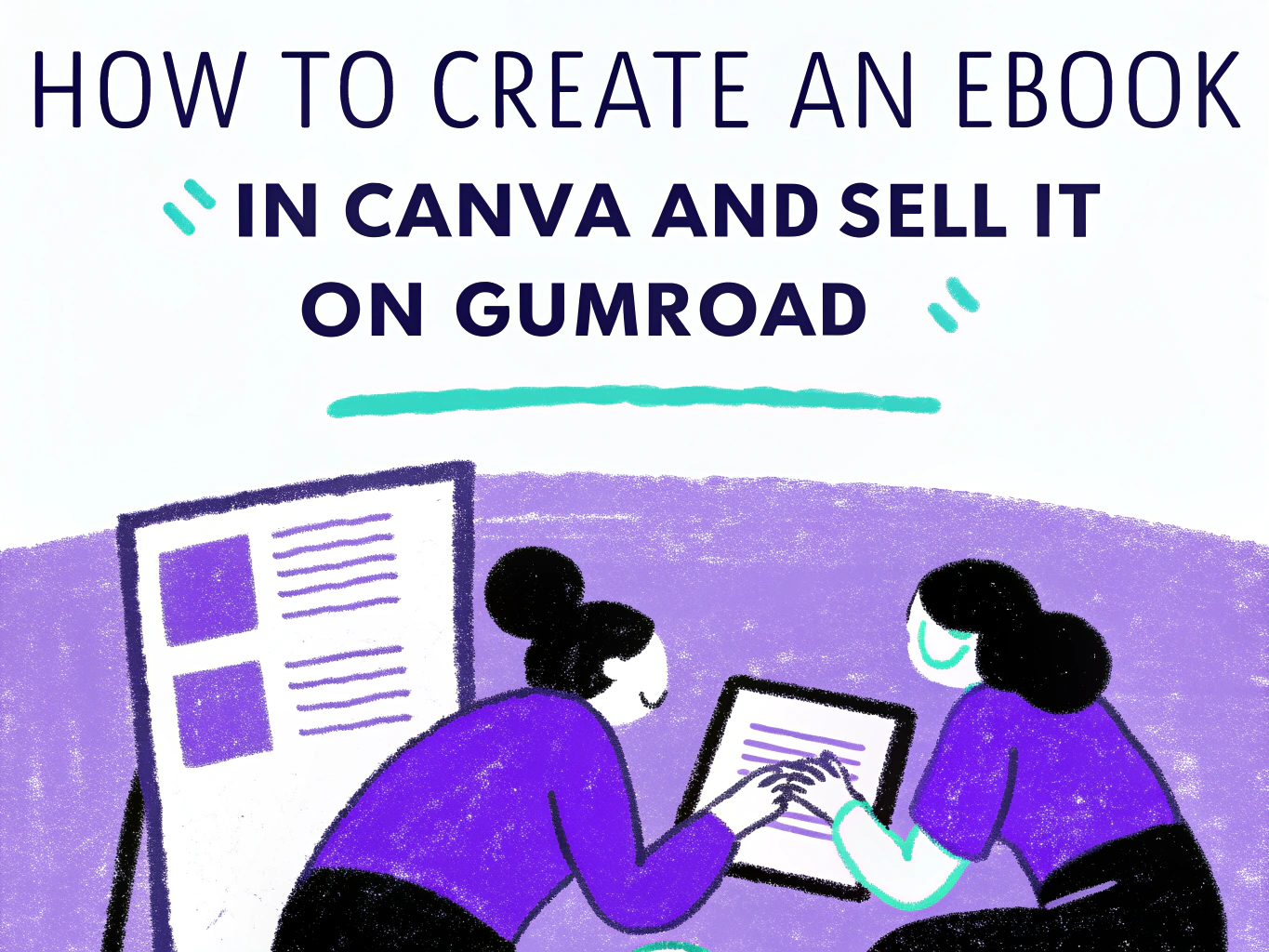
How to Create an eBook in Canva and Sell It on Gumroad
Creating and selling an eBook is one of the most straightforward ways to turn what you know into income online. You write something useful, design it in Canva, export it as a PDF, and upload it to Gumroad. No inventory, no shipping, no complicated technical setup. Once it is live it can sell while you sleep.
But most beginner guides skip the details that actually matter which Canva settings to use, how Gumroad fees work in practice before you price your product, and what separates an eBook that sells from one that sits unseen. This guide covers all of it.
Step 1: Choose a Topic That Solves a Specific Problem
Before you open Canva or create a Gumroad account, you need a topic worth writing about. This is the step that determines whether your eBook sells or sits with zero downloads.
The biggest mistake beginners make is writing about something broad. A generic eBook called “How to Be Productive” competes with thousands of others and appeals to nobody in particular. A specific eBook called “How to Manage Client Projects as a Solo Freelance Designer” speaks directly to one person who feels exactly that frustration and is actively looking for help.
The best eBook topics sit at the intersection of something you genuinely know and something a specific person is actively searching for. You do not need to be a world-class expert. You need to know more than your buyer knows and be able to explain it clearly.
A practical way to find topics that sell is to look at what people are already buying. Browse Gumroad’s discover section and filter by top products in a category you are interested in. Look at what questions come up repeatedly in Reddit communities, Facebook groups, and YouTube comment sections in your niche. Every unanswered question is a potential eBook topic.
Short, focused, and immediately actionable is the format that consistently outsells long comprehensive guides. People do not want another 300-page bible on a topic. They want the exact 20 to 30 pages that solve their specific problem right now.
Step 2: Write Your Content Before You Design Anything
This is the step most people do in the wrong order. They open Canva first, find a beautiful template, and then try to fit their writing into the design as they go. This creates a disjointed, inconsistent result because you’re making content decisions and design decisions simultaneously.
Write your entire eBook in Google Docs first. Get the full draft finished, edited, and organized into sections before you touch Canva. Break it into clear chapters or sections with descriptive headings. Write in a conversational tone rather than an academic one because readers of short-form eBooks respond far better to content that sounds like a knowledgeable friend talking to them.
A free lead magnet eBook typically runs 10 to 20 pages. A paid eBook that sells for $9 to $19 typically runs 25 to 50 pages. A premium paid guide priced at $25 and above can run 50 to 100 pages but only if every page delivers genuine value rather than padding word counts to look substantial.
Once your draft is complete, do one edit pass focused purely on clarity. Cut anything that does not directly serve the reader. Short sentences. Clear headings. Actionable content that the reader can apply immediately after reading.
Step 3: Set Up Canva Correctly Before You Start Designing
Open Canva and create a new design with custom dimensions. The choice you make here affects how your eBook looks across every device a reader might use.
For a screen-first eBook — one that readers will primarily read on a laptop, tablet, or phone — set your dimensions to 1080 x 1350 pixels or use Canva’s built-in A4 preset. For a print-friendly eBook, use A4 at 210 x 297mm or US Letter at 8.5 x 11 inches.
Search for “ebook” in Canva’s template library. Choose a template labeled as ebook, workbook, or guide. Avoid presentation or poster templates because they lack proper text hierarchy and page flow designed for multi-page documents.
When you choose a template, look for one with clear margins, readable body text sizing, and a consistent page structure you can duplicate across every chapter. The design should support your content, not compete with it. If a reader notices the design more than they absorb the content, the design is doing the wrong job.
Step 4: Customize Your Design for Consistency and Readability
Once you have your template open, apply these principles across every page before you start placing your written content.
Choose one display font for headings and one clean readable font for body text and stick to both throughout the entire eBook. Mixing three or four different fonts is one of the most common beginner design mistakes and it makes even well-written content look amateurish.
Set your body text to a minimum of 11 to 12 points for screen reading. Use 1.5 line spacing throughout for readability. Keep your margins generous — a cramped page feels harder to read regardless of how good the content is.
Build your core page types first before duplicating. Create one chapter opener page, one standard content page, and one section divider page. Once those three look exactly the way you want, duplicate them for every chapter rather than rebuilding from scratch each time. This keeps your design consistent across every page without additional effort.
Use Canva’s color palette tool to establish two to four brand colors and apply them consistently for headings, accent elements, and callout boxes. Your eBook should look like a cohesive product from the first page to the last, not like different sections designed on different days.
Step 5: Export Your eBook Correctly
When your design is complete, click Share in Canva, then Download, and choose PDF Standard.
PDF Standard is the correct choice for an eBook that readers will primarily read on screen. It compresses the file to a manageable size while maintaining sharp text and acceptable image quality. This is the format you should use for Gumroad delivery, email delivery, and any other digital distribution.
PDF Print is the alternative option in Canva. It produces higher resolution output intended for physical printing. For a digital eBook sold on Gumroad, PDF Print is unnecessary, produces significantly larger file sizes, and offers no visible quality improvement for screen reading. Use PDF Standard.
After downloading, open the PDF yourself and read through every page. Check that fonts rendered correctly, images are clear, text did not shift position, and the overall layout looks exactly as it did in the Canva editor. A small number of elements sometimes render slightly differently in PDF output and catching these before your buyers do saves you from negative reviews.
Name your file clearly and professionally. Something like “YourEbookTitle-2026.pdf” rather than “Canva Design-export-final-FINAL2.pdf” because the file name is visible to buyers when they download and it is part of the overall quality impression your product makes.
Step 6: Understand Gumroad’s Fees Before You Price Anything
This is the step almost every beginner guide skips and it is genuinely important to understand before you set your price.
Gumroad charges a flat 10% plus $0.50 per transaction for direct sales where customers find your product through a link you share yourself. On top of that, credit card processing fees through Stripe add approximately 2.9% plus $0.30 per transaction. So on a $15 eBook sale where you drove the traffic yourself, you keep roughly $12.20 after fees.
If a buyer finds your product through Gumroad’s own Discover marketplace rather than a link you shared, the fee jumps to a flat 30% which includes payment processing. On that same $15 sale discovered through Gumroad, you would keep roughly $10.50.
There are no monthly fees and no listing fees. Gumroad only makes money when you do, which makes it genuinely low-risk for beginners testing a product for the first time. As of January 2025, Gumroad also became a Merchant of Record for taxes, meaning they handle all global tax collection and remittance automatically. You do not need to configure VAT, GST, or sales tax settings yourself.
Understanding these fee tiers matters when you price your eBook. Price too low and the fixed $0.50 per transaction fee represents a disproportionately large cut. A $3 eBook on Gumroad leaves you with about $2.00 after the 10% and $0.50 fee, before card processing. The same logic that applies to template pricing applies here — pricing confidently protects your margin and signals quality to buyers.
Step 7: Set Up Your Gumroad Account and Product Page
Creating a Gumroad account takes under five minutes. Go to Gumroad, sign up with an email address, complete your profile with a name, photo, and brief bio, and connect your payment method for receiving payouts.
To create your product, click New Product and select Digital Product. Upload your PDF file. Gumroad handles secure file delivery automatically — every buyer receives a unique download link after purchase.
Your product page is your sales page and it deserves real attention. Write a product title that clearly communicates what the eBook is and who it is for. Write a description that opens with the specific problem your eBook solves, lists exactly what’s inside with enough detail for the buyer to make a confident decision, and tells them what they will be able to do after reading it.
Upload a cover image for your product. This is the visual buyers see before they read a single word of your description and it needs to immediately communicate that this is a professional, high-quality product. Design your cover in Canva using a clean layout with your eBook title, a relevant image or graphic, and your name or brand. Export it as a PNG file and upload it to Gumroad as your product thumbnail.
Set your price. For a beginner eBook in the 20 to 40 page range, a starting price of $9 to $19 is a practical range that is low enough to reduce purchase hesitation and high enough to signal genuine value. If your eBook solves a professional problem or contains genuinely specialized knowledge, $19 to $35 is a reasonable range for a well-presented product.
Gumroad also lets you offer a pay-what-you-want pricing option with a minimum floor. Some creators use this to build early sales volume and generate their first reviews before switching to a fixed price.
Step 8: Create Mockup Images That Show Your eBook
Buyers cannot open and browse your eBook before purchasing. Your product images are the only thing standing between a curious visitor and a completed sale.
Go back into Canva and use a device mockup template to show your eBook displayed on a laptop, tablet, or iPad screen. Show the cover page. Show one or two interior pages that demonstrate the design quality and content style. If your eBook has a particularly strong chapter or a compelling visual element, show that too.
These mockup images go into your Gumroad product page alongside your description. They turn an abstract digital file into something the buyer can visualize holding, reading, and using. That visualization is what converts interest into a sale.
Step 9: Market Your eBook Outside of Gumroad
Gumroad’s Discover marketplace will surface your product to some buyers but relying on it means paying the 30% marketplace fee on those sales and having limited control over your visibility. The sellers who build consistent eBook income drive their own traffic to their Gumroad link so they keep the full benefit of the lower 10% direct sale fee.
Pinterest is one of the highest-leverage free marketing channels for digital products. Create a pin image in Canva showing your eBook cover with a clear description of what it teaches, and link directly to your Gumroad product page. Pinterest traffic compounds over time and a well-made pin can drive sales months after you created it.
Short-form video on TikTok and Instagram Reels works particularly well for eBooks because you can show a quick scroll through the pages, highlight one insight from the content, or explain the problem your eBook solves in 30 to 60 seconds. You do not need a large following for this to work. A single video reaching the right audience can generate more sales than weeks of passive listing.
An email list is the most valuable long-term marketing asset for any digital product seller. Offer a shorter free version of your eBook or a single useful page from it in exchange for an email address. Every person who opts in has demonstrated they want what you are selling. When you launch a new eBook or run a limited sale, your email list is the first and most reliable place to announce it.
Frequently Asked Questions
Can I sell an eBook made in Canva legally?
Yes. Canva’s terms of service permit you to sell PDF documents and eBooks created using Canva’s free elements and templates as long as you have customized them into an original work. You cannot sell Canva templates as standalone editable files or resell Canva’s elements as individual assets. But a designed and written eBook exported as a PDF is a completely legitimate product to sell. If you use Canva Pro elements in your design, those are also covered for commercial use under the Pro license.
How long should my eBook be to sell on Gumroad?
There is no ideal length but shorter and more focused consistently outperforms longer and more comprehensive at the beginner level. A 20 to 40 page eBook that solves one specific problem in full is more sellable than an 80 page eBook that covers a broad topic shallowly. Once you have proven that buyers want what you are writing about, you can expand into longer or more comprehensive follow-up products.
Do I need PayPal to receive payments from Gumroad?
Not necessarily. Gumroad pays out via direct bank transfer in supported countries and via PayPal in others. The availability of direct deposit depends on your country of residence. Check Gumroad’s current payout documentation for the most up-to-date list of supported countries for each payment method. Payouts are processed every Friday for the previous week’s sales.
Should I offer my eBook for free to build an audience first?
Offering a shorter free version as a lead magnet while selling a more complete paid version is a strategy that works well for building an email list alongside generating direct revenue. Giving your full paid eBook away for free dilutes the value signal and trains your audience to wait for free offers rather than purchasing. A free taste that leads to a paid product is the more sustainable approach.
Final Thoughts
Creating an eBook in Canva and selling it on Gumroad is genuinely one of the most beginner-accessible paths to digital product income available in 2026. The tools are free, the process is learnable in a single afternoon, and the ongoing work of maintaining and marketing a digital product is manageable for anyone with a consistent habit of showing up.
What separates the eBooks that sell consistently from the ones that never find their audience is almost never the design quality or the length. It is the specificity of the topic, the clarity of the writing, and the confidence of the presentation. Get those three things right and you have built something worth selling.
Write something genuinely useful for a specific person. Design it with care. Price it confidently. Put it in front of the people who need it. That is the entire formula and it works every time it is executed honestly and well.

- 25+ Profitable Print on Demand Products to Sell - July 25, 2026
- 24+ Beginner Friendly Print on Demand Business Ideas - July 15, 2026
- 20+ Low Risk Print on Demand Products - July 5, 2026